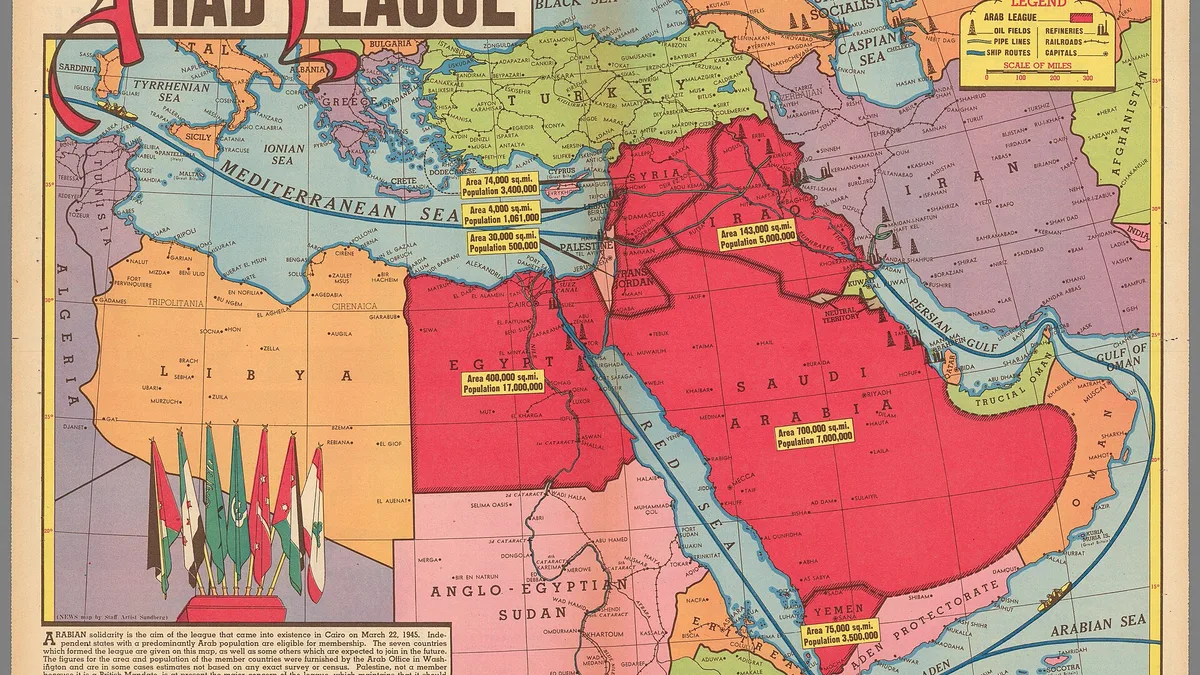
League Of Arab States
| Member states | Algeria, Bahrain, Comoros, Djibouti, Egypt, Iraq, Jordan, Kuwait, Lebanon, Libya, Mauritania, Morocco, Oman, Palestine, Qatar, Saudi Arabia, Somalia, Sudan, Syria, Tunisia, United Arab Emirates, Yemen |
|---|---|
| Original use | Promote coordination among member states in political, cultural, economic, and social affairs |
| Headquarters city | Cairo |
| Official language | Arabic |
| First created | 1945 |
| Governing instrument | Charter of the League of Arab States |
| Membership type | Regional intergovernmental organization |
Origin and history
The League of Arab States, commonly called the Arab League, originates from the Arab world of the Middle East and North Africa. Its formation was a direct political outcome of the broader Arab nationalist movement that gained momentum in the early 20th century. The foundational pact was signed in Cairo in the mid-1940s, specifically in 1945, by seven founding member states. The creation was significantly influenced by British diplomatic efforts during the Second World War, which aimed to secure Arab support. The immediate context included shared aspirations for post-colonial independence and a collective response to the establishment of Israel. The League's headquarters has remained in Cairo for most of its history, except for a period in the late 1970s when it was temporarily moved to Tunis.
What it is for
The League's primary purpose is to promote closer political, economic, cultural, and social cooperation among its member Arab states. It is designed to safeguard the independence and sovereignty of its members through a framework of collective security and diplomatic coordination. A core and enduring function is to coordinate a unified Arab position on the Palestinian issue, considering it a central cause for the Arab world. It aims to mediate and resolve disputes between member states through peaceful means, offering a platform for arbitration and negotiation. The organization also facilitates collaborative projects in areas such as education, health, communications, and trade through its specialized agencies. Furthermore, it serves as a regional bloc to represent common Arab interests in international forums and in relations with other global entities.
Overview
The Arab League is a regional intergovernmental organization comprising 22 member states across the Middle East and North Africa, including Palestine, which is represented by the Palestine Liberation Organization. Its governing structure consists of the Council, which is the supreme body where each member state has one vote, and a General Secretariat that handles administrative and executive functions. Decision-making on substantive matters, as outlined in its Pact, requires unanimity, which often leads to non-binding resolutions or lowest-common-denominator agreements to accommodate diverse political regimes. The League has established numerous specialized ministerial councils and agencies to manage cooperation in specific sectors like economics, justice, and health. It operates with a principle of respect for the sovereign state system, meaning its resolutions are generally not enforceable on member states without their consent. Over the decades, it has launched significant collective initiatives, such as the Arab Peace Initiative of 2002, while also being paralyzed by deep internal divisions during major regional crises.
What to know
The League's effectiveness is heavily constrained by the profound political and ideological rifts among its members, such as those between monarchies and republics or between rival regional powers. Its consensus-based model means that decisive collective action, especially military intervention as envisioned in its Joint Defence Treaty, is exceedingly rare and often unimplementable. Economic integration goals, like the long-proposed Arab Common Market, have progressed very slowly and are overshadowed by individual national interests and extra-regional trade agreements. The organization has a history of suspending members for violations of its norms, most notably Egypt following its peace treaty with Israel, though membership was later restored. It possesses limited independent institutional capacity, with most power residing with the member states themselves, making the Secretary-General's role largely diplomatic rather than executive. Observers should note that the League's pronouncements often represent aspirational Arab solidarity rather than actionable policy, and its influence varies dramatically depending on the specific issue and the degree of member state alignment.
Common questions
A common question is whether the Arab League can enforce its decisions on member states, to which the answer is generally no, as it lacks supranational authority and relies on political persuasion and consensus. People often ask about its relationship with the Gulf Cooperation Council (GCC) or the Organization of Islamic Cooperation (OIC), which are overlapping but distinct organizations with different memberships and primary focuses. Many inquire why the League has been perceived as ineffective in resolving major conflicts like the Syrian Civil War, which stems from irreconcilable divisions among members on supporting or opposing the Syrian government. A frequent question concerns the role of the Palestinian issue, which remains a central, unifying rhetorical pillar even when practical solidarity among members falters. Individuals also ask about membership criteria, which are based primarily on Arab identity, language, and culture, as seen in the inclusion of non-Middle Eastern members like Comoros and Djibouti. Another typical question is about the League's stance on interventions, such as its authorization of a no-fly zone in Libya in 2011, which was a notable exception to its usual inertia but later became highly controversial among members.
Pros and cons
A significant pro is that the League provides an indispensable permanent diplomatic forum for dialogue among Arab states, helping to manage and occasionally resolve inter-Arab disputes that might otherwise escalate. It fosters functional cooperation through its specialized agencies, which work on technical, social, and economic projects that benefit from regional standardization. The organization gives a collective, amplified voice to Arab perspectives on the international stage, particularly at the United Nations, which individual smaller states might lack. A major con is its chronic inability to take meaningful collective action during severe crises due to the unanimity rule and deep political splits, leading to perceptions of irrelevance. Member states often regret committing to its resolutions when those resolutions conflict with their immediate national interests or alliances, leading to non-compliance that undermines the League's credibility. A common mistake is to overestimate the League's capacity as a unified bloc akin to the European Union, when in reality it is a loose confederation of sovereign states with often competing agendas, resulting in symbolic rather than substantive outcomes.
Who it suits
The League suits sovereign Arab states seeking a platform for declaratory diplomacy and for projecting a sense of regional solidarity, especially on pan-Arab symbolic issues like the Palestinian cause. It is suited for smaller or less influential member states that benefit from the diplomatic cover and amplified voice the collective forum provides in regional and international affairs. The organization suits technocratic collaboration, as it benefits government ministers and officials in specific sectors like education, health, or telecommunications who can advance practical cooperation bypassing high-political divisions. It is less suited for states or situations requiring rapid, binding, and decisive collective security intervention or deep political integration, as its institutional design prevents such outcomes. The League also suits external powers or international organizations looking for a legitimizing regional endorsement for policies, though such endorsements can be fragile and non-unanimous. Ultimately, it suits an inter-Arab order that prioritizes state sovereignty above all else, accommodating a wide spectrum of governance models from monarchies to republics without demanding political conformity.
Latest League Of Arab States news
Latest reporting

United States and Argentina Launch Andes-Atlantic Corridor
The United States and Argentina have launched the Andes-Atlantic Corridor, a long-term infrastructure initiative focused on transportation, energy

U.S. Scales Up Ebola Response with $267 Million Pledge
The United States has announced an additional $267 million in direct health and humanitarian assistance for the Ebola outbreak in the Democratic...

Russia Retains Leverage Over US Through Uranium Supply
The United States remains heavily dependent on Russian enriched uranium for its nuclear reactors despite reciprocal import bans, with waivers allowing
US Deports Asylum Seekers to Abusive Regime in Equatorial
The United States has deported at least 66 third-country nationals to Equatorial Guinea under a Trump-era deal, paying the dictatorship $7.5 million.

Baltic states assess low risk of Russian
Security analysts from Estonia, Latvia, and Lithuania argue that a Russian land incursion into the Baltics is unlikely while the war in Ukraine...
US urged to back UN Libya roadmap with action, not only
A new UN-help agreement aims to break Libya's political deadlock and pave the way for elections. The United States faces a test of its stated support...