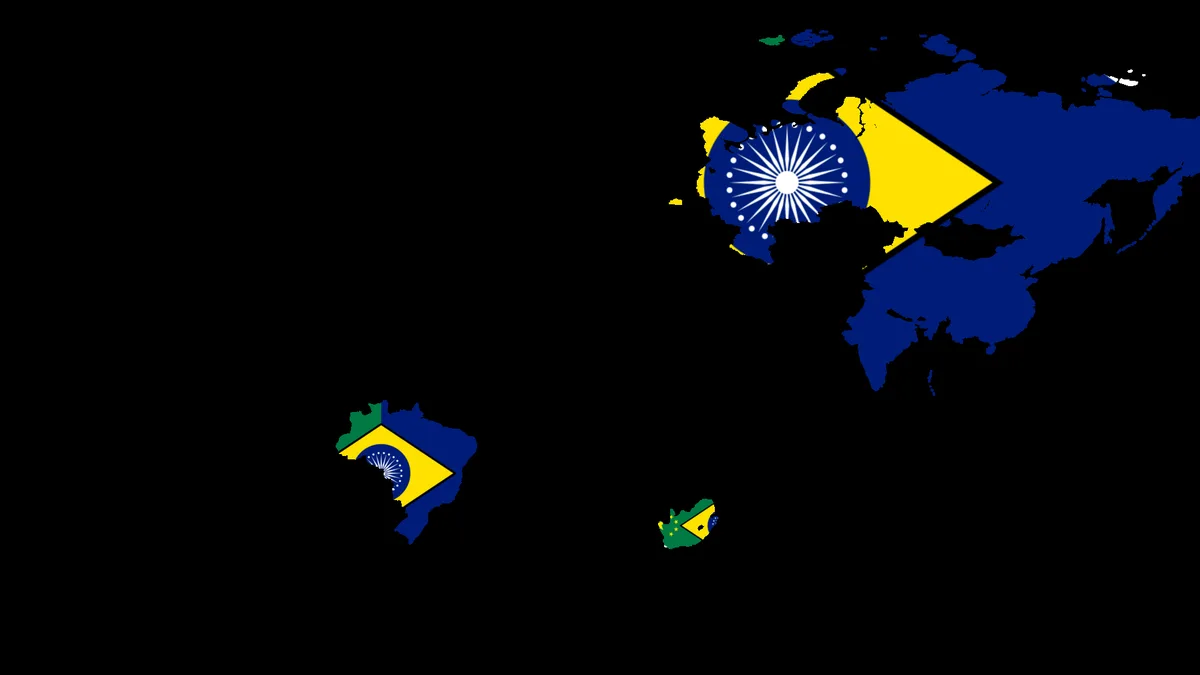
Brics
| Original use | Forum for dialogue on economic cooperation |
|---|---|
| First members | Brazil, Russia, India, China |
| Expansion | Subsequent addition of new member states |
| Key instrument | Annual summit and rotating chairmanship |
| Focus areas | Political, economic, and cultural cooperation |
| Decision-making | Based on consensus among members |
| Official languages | English plus the languages of member states |
Origin and history
The term BRICS originated from an investment bank analysis in the early 2000s. It was coined by economist Jim O'Neill of Goldman Sachs in a 2001 paper titled "Building Better Global Economic BRICs." The initial acronym BRIC referred to Brazil, Russia, India, and China as four large, fast-growing economies with significant future potential. The concept evolved from a financial analysis term into a formal diplomatic grouping by the late 2000s. The first formal BRIC foreign ministers' meeting took place in 2006 on the sidelines of the UN General Assembly. South Africa joined the grouping in 2010, after which it became known as BRICS with an uppercase 'S'.
What it is for
BRICS functions as a multilateral forum for cooperation among its member states across several domains. Its primary stated purposes are to enhance political and security cooperation among major emerging economies. It serves as a platform to coordinate positions on global governance reform, particularly regarding institutions like the IMF and World Bank. The forum aims to deepen and expand economic cooperation, trade, and investment among member countries. It also seeks to foster collaboration in areas such as science, technology, innovation, and culture. A key function is to provide a collective voice for the interests of the Global South within the international system.
Overview
BRICS is not a formal treaty-based organization but an intergovernmental grouping operating through consensus. Its structure is built around annual summits of heads of state and government, which are its highest decision-making body. Coordination occurs through meetings of foreign ministers, finance ministers, central bank governors, and numerous sectoral working groups. The New Development Bank (NDB) and the Contingent Reserve Arrangement (CRA) are its two major institutional financial arms. The NDB, headquartered in Shanghai, finances infrastructure and sustainable development projects. The CRA provides a framework for mutual financial support and protection against global liquidity pressures.
What to know
Membership has expanded beyond the original five, with several new states formally joining in the 2020s. The group operates without a formal charter or secretariat, relying on rotating annual presidencies to set the agenda. Decisions are made through consultation and consensus, which can sometimes lead to vague or diluted joint declarations. The economic and political diversity among members, encompassing democracies and autocracies, and varying economic models, is a defining characteristic. BRICS summits often produce lengthy communiqués covering a wide range of global issues, from climate change to terrorism. The grouping's influence is derived more from the aggregate economic weight and population of its members than from deep institutional integration.
Common questions
A common question is whether BRICS aims to be a direct geopolitical rival to the G7 or Western alliances. Another frequent inquiry concerns the criteria and process for new countries to join the grouping. Many ask about the practical impact and lending capacity of the New Development Bank compared to established institutions like the World Bank. People often question how the group reconciles the divergent, and sometimes conflicting, national interests of its member states. There is curiosity about whether BRICS will develop a common currency to challenge the US dollar, a topic frequently discussed but with little substantive progress. Observers also commonly ask about the tangible outcomes and binding agreements produced by the annual summits beyond symbolic statements.
Pros and cons
A significant pro is that it provides a coordinated platform for major emerging economies to advocate for a more multipolar world order. It has successfully established functional financial institutions, the NDB and CRA, which offer alternatives to Western-dominated funding sources. The forum facilitates valuable diplomatic and economic linkages between members across different continents. A major con is the inherent strategic and political divergence between members, such as border disputes or differing allegiances in global conflicts, which often prevents strong, unified stances. The consensus model can lead to lowest-common-denominator outcomes that lack substantive policy commitments. Some member states may regret the financial and diplomatic investment when the group's declarations fail to translate into concrete national benefits or when internal rivalries surface.
Who it suits
BRICS suits national governments seeking to diversify their international alliances and reduce perceived over-reliance on Western political and economic frameworks. It is relevant for policymakers and analysts focused on global governance reform and the shifting balance of economic power. The grouping suits countries that prioritize South-South cooperation and wish to amplify a collective voice for developing nations on issues like climate finance and trade rules. It appeals to states that favor flexible, non-binding multilateral engagement over rigid treaty-based obligations. The associated financial institutions suit member countries and other developing nations seeking infrastructure and development loans with potentially fewer conditionalities than traditional lenders. It is less suited for entities seeking a tightly integrated, single-issue bloc with rapid, unified decision-making capabilities.
Latest Brics news
Latest reporting
Brazil's BRICS Diplomacy Balances Reform and Cohesion
Brazil's foreign minister attended the BRICS summit in New Delhi, where the bloc reaffirmed support for the U.N. and the Paris climate agreement.
BRICS Summit in Delhi Faces Divisions
BRICS faces internal security discord ahead of its September 12 summit in New Delhi, following its major expansion with five new members.