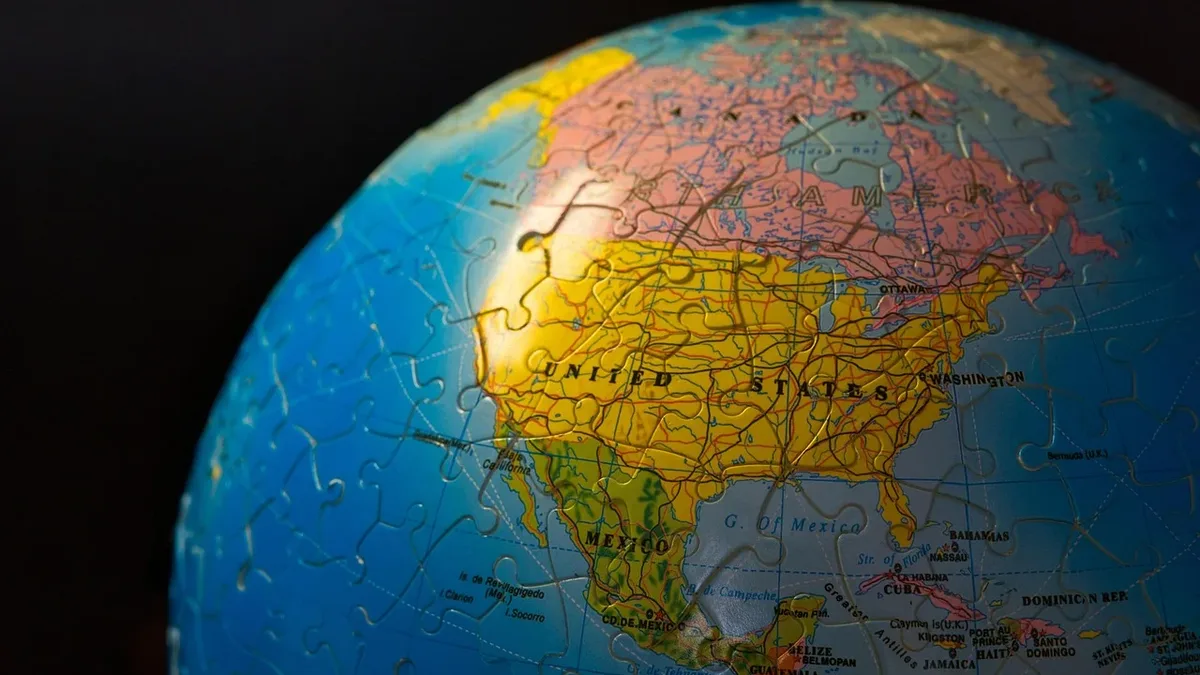
Us And Mexico
| Governing document | Treaty of Guadalupe Hidalgo (1848) and subsequent treaties |
|---|---|
| Border length | Approximately 3,145 kilometers (1,954 miles) |
| Original territorial cession | Mexican Cession (1848) |
| Diplomatic relations established | 1825 (following U.S. recognition of Mexican independence) |
| Primary trade agreement | United States–Mexico–Canada Agreement (USMCA, effective 2020) |
| Original purpose of relationship | Diplomatic recognition and territorial demarcation |
| Key bilateral forum | High-Level Economic Dialogue |
Origin and history
The relationship originates from the contiguous border between the United States of America and the United Mexican States, established following the annexation of Mexican territory by the U.S. after the Mexican-American War in the mid-19th century. Its modern framework was fundamentally shaped by the Treaty of Guadalupe Hidalgo in 1848 and the Gadsden Purchase of 1853, which fixed the international boundary. The early 20th century was marked by the Mexican Revolution and significant U.S. interventions, influencing decades of wariness. The relationship evolved through the Bracero Program of the mid-20th century, which formalized large-scale labor migration. A pivotal shift occurred in the late 20th century with the negotiation and implementation of the North American Free Trade Agreement (NAFTA) in the 1990s. The post-NAFTA era has seen the relationship become increasingly defined by complex economic integration alongside persistent challenges in security and migration management.
What it is for
The bilateral relationship serves to manage the extensive flow of goods, capital, and people across the nearly 2,000-mile shared border. It is designed to facilitate mutually beneficial trade and economic growth through integrated supply chains, particularly in automotive, agriculture, and manufacturing sectors. A core purpose is to cooperate on regional security issues, including the interdiction of illicit drug trafficking and transnational criminal organizations. The framework exists to negotiate shared environmental concerns and natural resource management, such as water rights from the Colorado River. It provides a structure for diplomatic dialogue on migration, aiming to balance enforcement with humanitarian protocols and labor market demands. The relationship also establishes protocols for consular protection and the rights of the millions of citizens of each country residing in the other.
Overview
The U.S.-Mexico relationship is governed by a dense network of treaties, intergovernmental agreements, and institutions like the United States-Mexico-Canada Agreement (USMCA), which succeeded NAFTA. Key diplomatic mechanisms include the High-Level Economic Dialogue and regular cabinet-level meetings on security and law enforcement. The relationship is characterized by profound asymmetry in economic size and military power, which influences negotiation dynamics across all issues. Civil society and business linkages are extensive, with over a million legal border crossings daily and deep familial and cultural ties spanning generations. Major bilateral issues are inherently interconnected, where policies on trade directly impact migration patterns and security cooperation. The institutional framework is continuously tested by domestic political cycles in both countries, which can lead to rapid shifts in tone and policy priorities.
What to know
The United States is Mexico's largest trading partner, while Mexico is typically the United States' second-largest trading partner, with bilateral trade exceeding half a trillion dollars annually. Mexico is the top origin country for immigrants living in the United States, both documented and undocumented, making migration a perpetually salient political issue. Security cooperation is formalized through initiatives like the Mérida Initiative, which involved U.S. funding and training for Mexican security forces, though its model has been revised over time. Water scarcity in border regions, governed by a 1944 treaty, is a growing source of bilateral tension, especially during drought conditions. The concept of "shared responsibility" is frequently invoked in official discourse regarding drug trafficking, implying obligations for both demand reduction and supply interception. The border itself is managed by a combination of physical barriers, technology, and personnel from multiple federal agencies, with ports of entry representing critical economic chokepoints.
Common questions
A common question is how the USMCA differs from NAFTA, focusing on updated rules for automotive origin, labor and environmental standards, and digital trade provisions. Many ask about the process for seeking asylum at the U.S.-Mexico border, which involves complex U.S. legal procedures and agreements with Mexico to accept certain asylum seekers. People frequently inquire about the primary drivers of migration from Mexico, which include economic disparity, violence, and family reunification, with the relative weight of these factors shifting over time. A recurring question concerns the legality and impact of remittances, which are funds sent by migrants in the U.S. to families in Mexico, constituting a major source of foreign income for Mexico. There is often confusion about the role of the Mexican military in domestic law enforcement and how U.S. security cooperation interacts with this role. Questions also arise about the rights of U.S. citizens detained in Mexico and Mexican citizens detained in the U.S., governed by consular treaties and often dependent on individual circumstances.
Pros and cons
A significant pro is the creation of a highly competitive regional manufacturing bloc, boosting investment and lowering consumer costs through integrated production. The deep people-to-people ties foster cultural exchange and form a social buffer during periods of political friction. Established diplomatic channels allow for crisis management, even when public rhetoric is hostile, preventing total breakdowns in cooperation. A major con is the relationship's vulnerability to political populism and unilateral actions, such as sudden tariff threats, which create business uncertainty and can damage long-term planning. The securitization of the border often conflicts with economic and humanitarian goals, leading to policies that are both costly and criticized as inhumane. A common mistake is assuming the relationship can be managed through enforcement alone, underestimating the powerful economic and social forces that drive migration and trade, leading to cyclical policy failure. Many communities on both sides of the border regret the entrenched presence of criminal organizations and violence, which is often exacerbated by the profitable illicit trade fueled by U.S. demand.
Who it suits
This relationship suits policymakers and diplomats who can engage with its inherent complexity and asymmetry, avoiding simplistic zero-sum frameworks. It benefits corporations and manufacturers that rely on just-in-time supply chains and can navigate the specific rules of origin under the USMCA. The framework suits border states and municipalities that have developed institutional expertise and economic models dependent on cross-border flows, despite the challenges. It is necessary for migrants and families with transnational lives, who rely on its stability for remittances, travel, and consular protections, however imperfect. The relationship suits researchers and analysts who study interdependency, as it serves as a premier case study of a deeply integrated yet unequal bilateral dynamic. It ultimately demands participants who accept that gains are often incremental and that managing conflicts is a continuous process rather than achieving a final resolution.